

Short Summary
(Artificial Intelligence) AI data centers are being approved and delivered at a pace that can outstrip electrical grid planning, water resilience, community trust, and basic transparency. Many proposals are technically feasible and still ethically messy. This article introduces the Ethical Infrastructure Assessment Model (EIAM), a stage-gate tool that helps sponsors and project teams translate ethical concerns into practical Go, Mitigate, or No Go decisions.
Why did this stop being “just another facility”
AI data centers are not only IT projects. They are resource-intensive infrastructure that concentrates electricity, water, and operational impacts in specific locations. That creates a new class of governance questions that traditional delivery metrics (scope, cost, schedule, quality) do not fully capture.
In my own reviews of proposed data center facilities, the governance risks often reveal themselves in very ordinary moments. In one recent review in the Northeast, the sponsor’s “low carbon” claim sounded convincing until we traced the marginal generation during peak hours. On the hottest days, the incremental load was effectively being served by gas peakers, which immediately changed the carbon and community impact conversation. I have also seen proposals where water use was treated as a footnote until the local water authority flagged seasonal stress conditions. That single note turned “standard cooling” into a governance decision: redesign, relocate, or accept a Mitigate outcome with enforceable limits. And when community resistance shows up, it usually does not start with ideology. It starts with basic questions that the project team cannot answer cleanly: expected water draw, backup generator runtime, and what long-term benefits will remain after construction. When those answers are vague, the transparency gap becomes the risk, not the technology.
The questions that keep showing up are straightforward and uncomfortable:
· Can the local grid support the load without long-term reliability risk?
· If the grid expands to support it, who pays and who benefits?
· Is water use compatible with the watershed’s stress profile?
· Are community impacts treated as obligations or as a permitting box to check?
· What types of AI workloads will this site enable, and under what safeguards?
These are not “soft” questions. They are governance questions. And they often determine whether a project should exist in that location at all.
What EIAM is
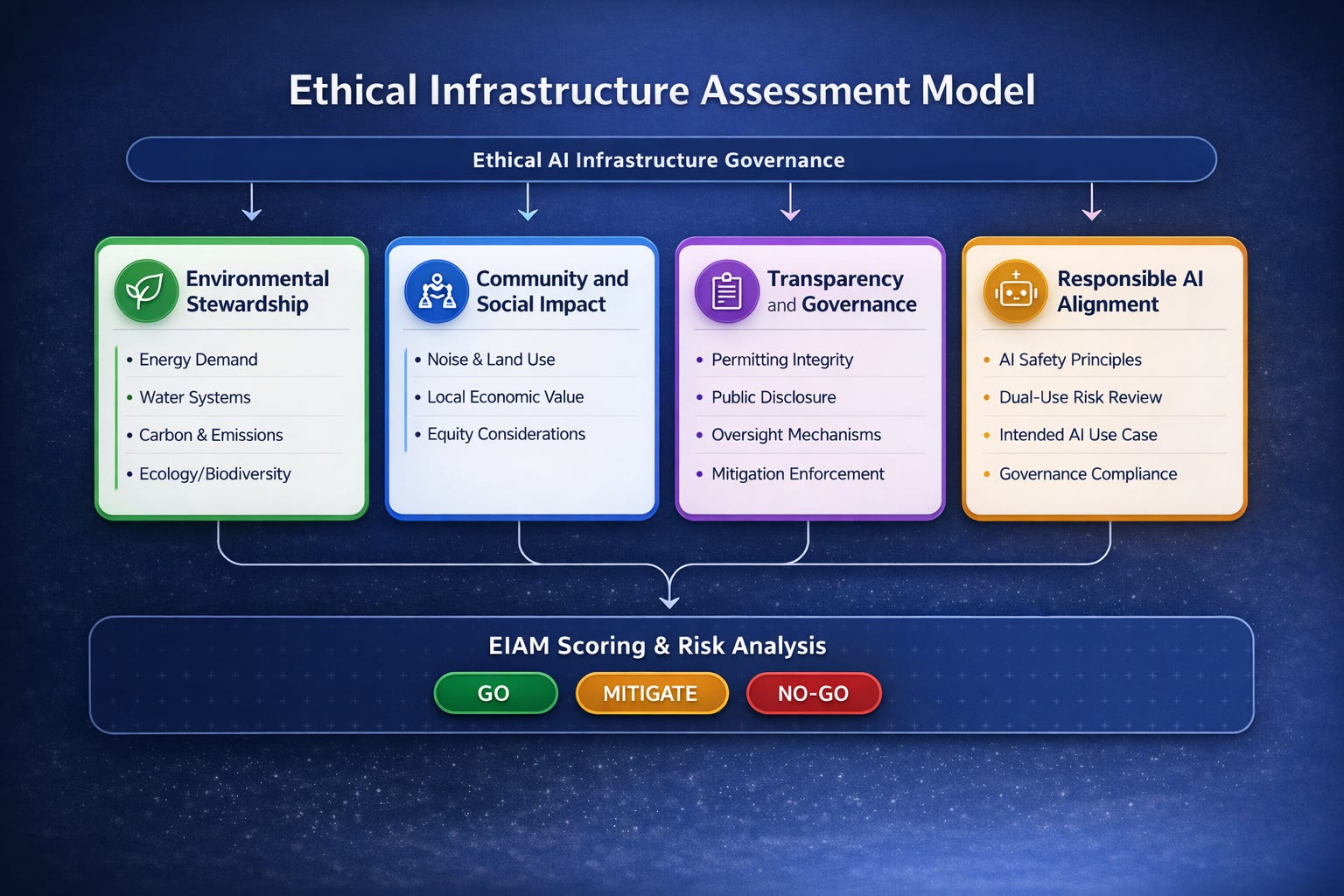
The Ethical Infrastructure Assessment Model (EIAM) is a governance tool for evaluating proposed data center projects. It does not replace engineering, permitting, or financial analysis. It sits alongside them, so ethical risk is surfaced early, documented, and used to inform stage-gate outcomes.
EIAM organizes the decision into four pillars:
1. Environmental Stewardship
2. Community and Social Impact
3. Transparency and Governance
4. Responsible AI Alignment
Each pillar is assessed using a small set of practical questions and indicators. The output is operational: Go, Mitigate (approve only with specific, enforceable conditions), or No Go.
Figure 1. Ethical Infrastructure Assessment Model (EIAM)
The four pillars in plain project language
Pillar 1: Environmental Stewardship
This pillar asks whether the project is environmentally defensible in its proposed form and location. It pushes teams to move past generic “green” claims and address location-specific realities.
Typical prompts:
· Energy demand and peak load behavior
· Carbon intensity of electricity supply
· Cooling approach and direct water use
· Indirect water use via electricity generation
· Emissions from backup generation and operations
· Land conversion and ecosystem impacts
A facility can be efficient and still be wrong for a water-stressed basin or a constrained grid. EIAM makes that explicit early.
Pillar 2: Community and Social Impact
This pillar asks whether the people living with the impacts receive fair value, not just symbolic engagement.
Typical prompts:
· Noise, lighting, traffic, and compatibility with surrounding land use
· Permanent job creation and job quality relative to incentives
· Distribution of burdens and benefits, especially for already-burdened communities
· Credibility of community benefits and whether they are measurable
A project can be legally compliant and still be socially extractive. This pillar forces that question into the stage-gate record.
Pillar 3: Transparency and Governance
This pillar asks whether the project is trustworthy because it is governable, not because the sponsor asks to be trusted.
Typical prompts:
· Standard permitting versus shortcuts or exceptions
· Public disclosure of energy, water, emissions, and incentive details
· Independent monitoring, auditability, and enforcement authority
· Specificity and enforceability of mitigation commitments
If mitigation cannot be measured and enforced, it is not mitigation.
Pillar 4: Responsible AI Alignment
This pillar treats the data center as a long-term commitment to specific AI futures, not as a neutral box.
Typical prompts:
· Responsible AI governance within the sponsoring organization
· High-risk or dual-use posture, and whether it is acknowledged and managed
· Clarity on intended workload categories (at least at a high level)
· Alignment with emerging AI standards, audits, and regulatory expectations
Public agencies may not control workloads directly, but they can still require transparency and due diligence. Private sponsors can go further through tenancy and governance commitments.
How to use EIAM without adding bureaucracy
EIAM works best as a lightweight stage-gate add-on, not a giant scoring spreadsheet.
A practical workflow:
Define the decision scope. What decision is being made now: site selection, early approval, expansion, or tenancy strategy?
Choose a small set of prompts. Select 4 to 8 prompts per pillar based on local risks.
Score with definitions and evidence. Use a consistent scale (for example, 1 to 5) with clear definitions. Document the evidence and uncertainties.
Set thresholds. Decide in advance what triggers Mitigate or No Go. Example: severe water stress with no enforceable limits.
Document and decide. Record the ethical risk profile and the Go, Mitigate, or No Go outcome in the decision log. If Mitigate, list the conditions, owners, and verification method.
Two rules keep EIAM credible:
· A strong score in one pillar should not cancel out a very weak score in another.
· Mitigation must be enforceable.
What “Mitigate” should look like in practice
A Mitigate outcome should never be “we will try.” It should be a short, enforceable list of conditions that must be satisfied before approval is final or before the project is allowed to scale.
Examples of Mitigate conditions:
· Publish verifiable energy and water assumptions, with third-party monitoring
· Commit to enforceable limits or triggers tied to watershed stress conditions
· Define binding community benefits tied to measurable outcomes
· Establish independent reporting on generator runtime and emissions
· Provide a responsible AI governance statement and dual-use risk posture suitable for public review
If the sponsor cannot accept enforceable conditions, the governance signal is clear: the project is not ready for a Go decision.
Why this matters to PMI practitioners
Projects are technical systems and social systems. AI data centers make this visible by tying together grid reliability, water resilience, land use, incentives, and public trust.
EIAM helps project professionals do three practical things:
· Bring ethical risk into governance early, before backlash and rework
· Translate broad debate into conditions, thresholds, and enforceable commitments
· Protect the project team by making decisions transparent and documented
When “Can we build it?“ is the only question, governance is incomplete. EIAM helps teams add the question stakeholders ultimately care about: “Should we build it here, like this, at all?”
Sources and Further Reading
· On the Dangers of Stochastic Parrots (Bender et al., 2021)
· Atlas of AI (Crawford, 2021)
· Big Data Ecologies (Hogan, 2018) PDF
· How to stop data centres from gobbling up the world’s electricity (Jones, 2018)
· Recalibrating global data center energy-use estimates (Masanet et al., 2020)
· Data centre water consumption (Mytton, 2021)
· United States Data Center Energy Usage Report (Shehabi et al., 2016) PDF
· 2024 United States Data Center Energy Usage Report (Shehabi et al., 2024)
· The environmental footprint of data centers in the United States (Siddik et al., 2021)
· The water use of data center workloads (Lei et al., 2025)
· What Happens When Data Centers Come to Town? (Nguyen & Green, 2025) PDF
· Sustainability as a new school of thought in project management (Silvius, 2017)
· Global data center expansion and human health (Tao & Gao, 2025)
· Environmental impact and net-zero pathways for sustainable AI servers in the USA (Xiao et al., 2025)
· PMBOK Guide and The Standard for Project Management (PMI)
Author Bio
Hatim Elnueri is an independent researcher and a senior project controls leader with more than twenty years of experience in project governance, scheduling, risk management, and infrastructure delivery. His work focuses on ethical infrastructure governance for AI-related data center development and on integrating sustainability and responsible AI trans