

Recently, while scrolling aimlessly on Instagram, I came across a singer named LoFiLulla. She looked real. She sounded real. The performance was intimate, emotional, and strangely polished in a way that immediately pulled me in.
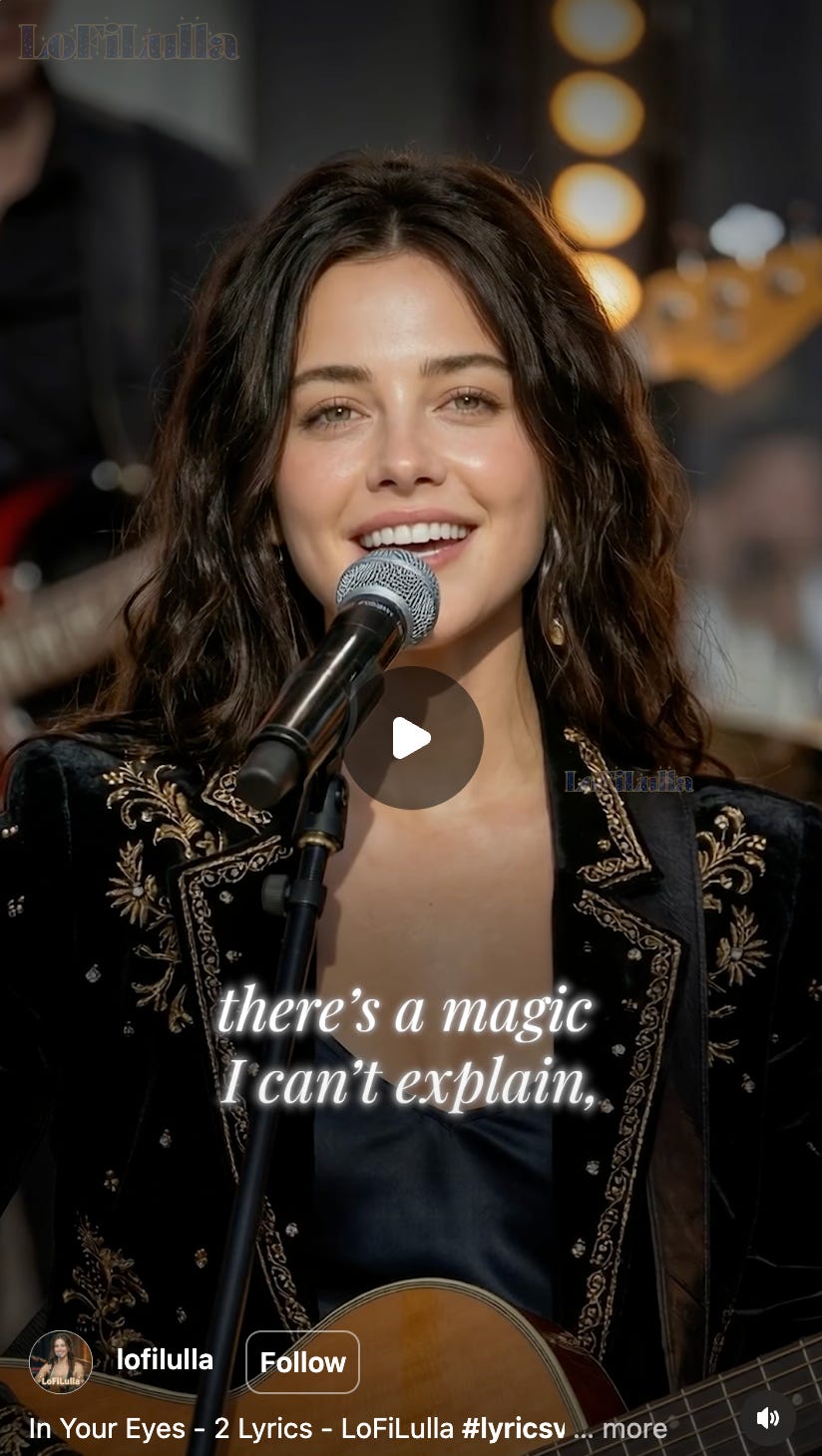
Image Grab: LoFiLulla Instagram Page
She was singing a song I could not quite place, somewhere between In Your Eyes by Peter Gabriel and I Can’t Explain by The Who. The lyrics went:
“In your eyes there’s a magic I can’t explain
a quiet spark like sunlight after rain
every breath you take it carries me away
like a kite that your winds lift high each day.”
Here is the full “short” song in YouTube: In Your Eyes - 2 Lyrics - LoFiLulla
The whole thing was beautifully staged. The lighting rose and dimmed with the emotion of the lines. Her face carried just enough feeling to seem believable. The voice had warmth. The timing was perfect. It all felt carefully tuned to produce exactly the right emotional effect.
I was surprised I had never heard of her before.
So I went to her Instagram page and found dozens of short reels of her singing classics and familiar-sounding songs in multiple languages. Hindi. Spanish. English. One after another. Same beauty. Same softness. Same emotional intimacy. Same flawless packaging.
Then I googled her.
She was not a real singer. She was AI.
I will admit it plainly: it was the first time AI truly fooled me in this way.
And my immediate reaction was not wonder. It was sadness, followed by worry.
Not because the technology was impressive. It was. Not because I am against tools or innovation. I am not. What bothered me was something deeper and more human. It felt as if I had just been shown a preview of a future where music no longer needs a musician, only a system good enough to imitate one.
That is the part I cannot shake.
Because I know what real music looks like at ground level.
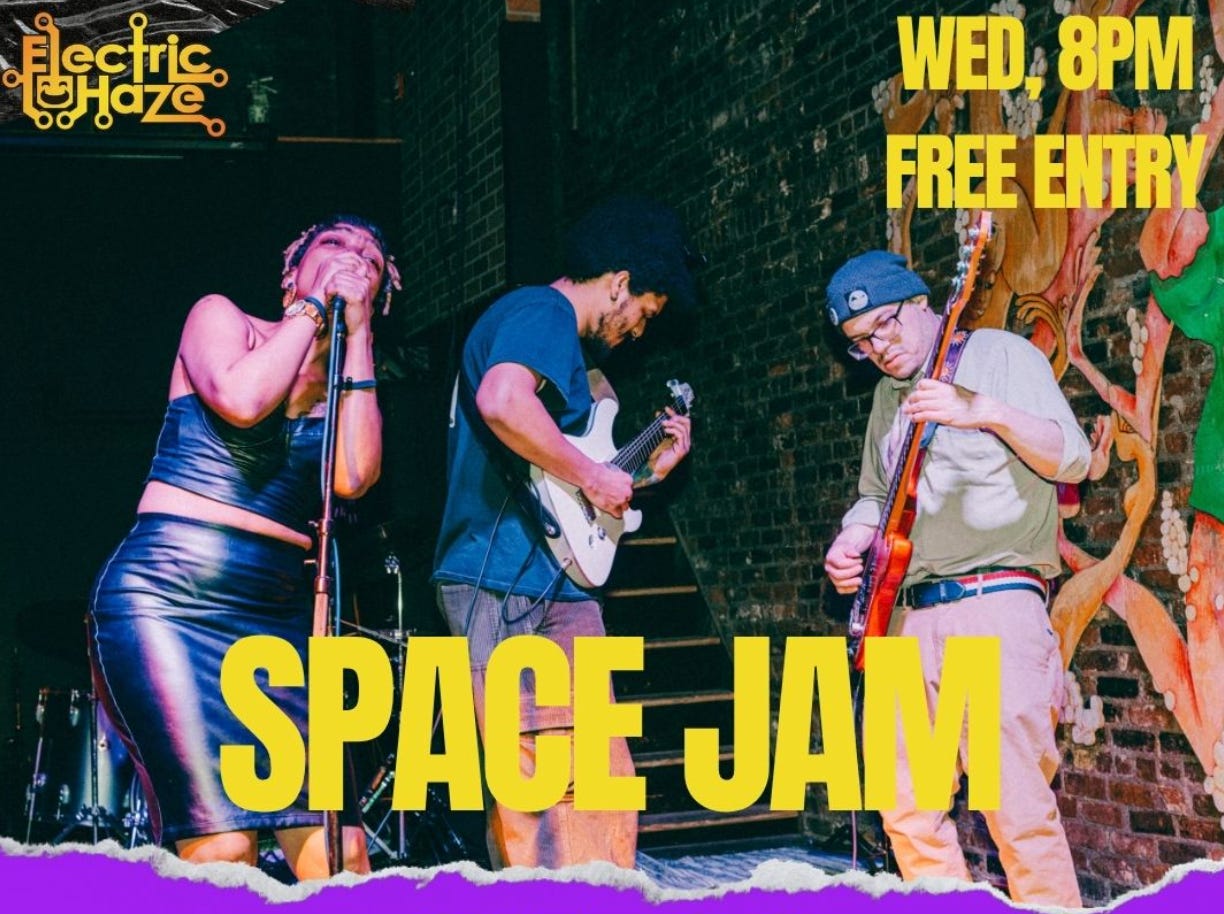
Image grab: Electric Haze - Worcester MA facebook page
I see it in the free-style artist nights I go to, where emerging performers get on stage not for money or fame, but for the chance to try, to fail, to improve, and to support each other. I see singers miss a note, laugh, recover, and keep going. I see people testing songs that are not ready yet. I see nervousness, courage, awkwardness, growth.
I see the human thing itself. The risk. The effort. The vulnerability of standing in front of other people with only your voice, your instrument, and whatever truth you can carry into a room that night.
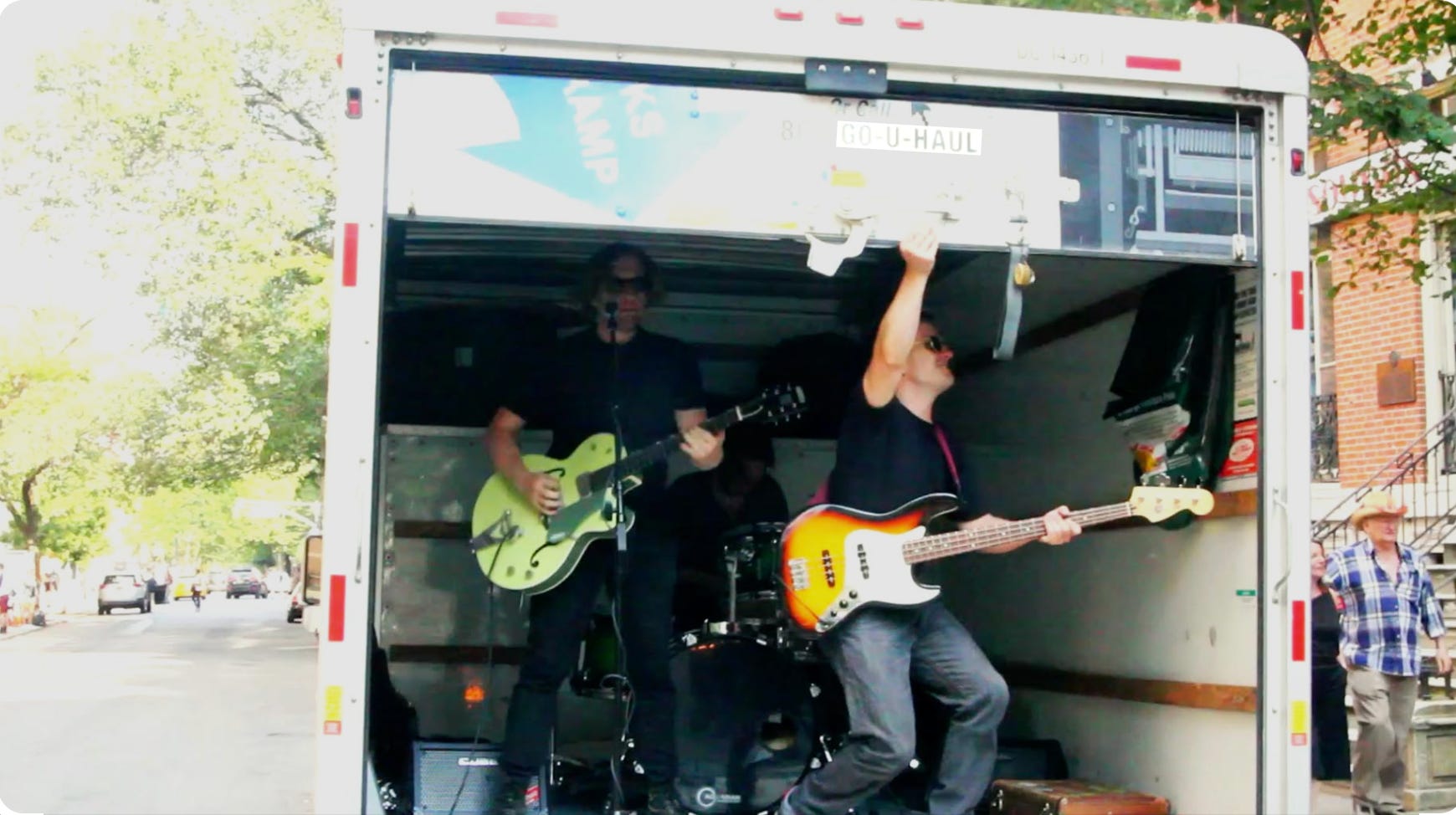
Image Copy Right U-Haul: U-Haul a Moving Stage for Slim Wray Music Video in NYC | My U-Haul Story
I see it too in the small bands around New England, people hauling gear into tiny venues, playing to modest crowds, hoping someone listens closely enough to come back next time. They are not algorithms. They are not content pipelines. They are human beings trying to build a voice and a life in art.
And that is why this matters.
The problem with AI-generated music is not only that it can mimic the sound of a song. The problem is that it enters a world where real artists are already struggling for attention, recognition, and income, and it competes with them on completely inhuman terms.
It does not get tired.
It does not need years to find its voice.
It does not need rehearsal spaces, collaborators, or the courage to bomb in public.
It does not carry the cost of becoming.
It can generate endlessly. It can test endlessly. It can adapt endlessly. It can sing in multiple languages, in multiple moods, with multiple faces and aesthetics, until it finds what keeps people watching for fifteen more seconds.
That is not artistry in the way we have historically understood it. That is optimization.
And the danger is not just the existence of that optimization. The danger is that our platforms are built to reward it.
Spotify, Instagram, TikTok, YouTube, all of them are designed around attention. Around what keeps you scrolling, clicking, looping, and staying. In that environment, the winner is not always the artist with the deepest voice or the most original vision. Often the winner is the one most perfectly engineered to trigger immediate reaction with minimal friction.
That is what makes this more than a curiosity. It is not about one fake singer with a pretty face and a soft voice. It is about an entire ecosystem slowly training audiences to consume music as mood product, emotional wallpaper, and algorithm-friendly content.
And once that happens, taste begins to erode.
Taste is not just preference. Taste is cultivated attention. It is the ability to tell the difference between something lived and something manufactured to simulate lived feeling. It is the patience to sit with work that is difficult, strange, unfinished, or deeply personal. It is the ability to value a rough edge when that rough edge carries a real human signature.
But if listeners are constantly fed perfectly packaged synthetic performances, then taste gets retrained. It becomes less about discernment and more about instant emotional compliance. Whatever sounds good enough, looks beautiful enough, and slides smoothly enough into the feed starts to feel like music. And maybe technically it is music. But culturally it is doing something thinner. It is flattening our standards while imitating the appearance of feeling.
That is what I mean by the hollowing out of taste.
And culture is next.
Culture is not just a pile of consumable artifacts. Culture is built through scenes, communities, local histories, shared references, influences, arguments, experiments, and failures. It grows through people making things with and around each other. It grows through friction. Through memory. Through place.
A synthetic music persona has no scene. No childhood influences. No nights playing to six people in a half-empty room. No hard-earned evolution. No community of peers pushing each other forward. It can imitate the output of culture without having actually come from one.
That may not matter if all you want is a pleasant clip while scrolling in bed. But it matters enormously if you care about culture as something living and human.
What worries me is that this kind of AI music does not simply join the cultural landscape. It displaces attention within it. Every stream, every recommendation slot, every passive listen, every viral reel absorbed by a synthetic performer is part of a larger shift away from artists who are still trying to break through the old way, with difficulty and dignity.
And then there is art itself.
Art is not valuable only because it is beautiful. It is valuable because somebody meant it.
Somebody suffered for it, or obsessed over it, or failed repeatedly before arriving there. Somebody brought a life into it. A history. A wound. A strange vision. A stubborn commitment. Art is not just output. It is expression anchored in a person.
That does not mean every human song is profound, or every AI-generated song is empty. But it does mean that replacing the artist with a synthetic approximation changes the moral character of the thing. It turns expression into simulation. It gives us the surface of feeling without the burden of a feeling subject behind it.
And I think people sense that, even when they cannot articulate it.
That was the sadness I felt when I realized LoFiLulla was not real. It was not embarrassment at being fooled. It was grief at how easy it had become to fabricate intimacy.
Because that is really what this is selling: fabricated intimacy at scale.
A beautiful face. A believable voice. A short clip. A moment of emotional suggestion. Just enough to make you feel that you have encountered a person, when in fact you have encountered a machine-mediated product designed to behave like one.
I am not arguing that AI has no place in music. I think it does. Used as a tool by real musicians, it can help with production, experimentation, arrangement, accessibility, and all kinds of creative exploration. There is nothing inherently unethical about technology helping artists expand what they can do.
But that is very different from building synthetic performers to flood platforms with emotionally optimized music products that compete directly with struggling human artists for revenue and visibility.
Those two things are not the same, morally or culturally.
AI as instrument is one future.
AI as replacement content is another.
The first can deepen creativity. The second risks emptying it out.
And listeners should care about this too, not just artists. Because when enough synthetic music gets shoved into our feeds, we do not simply consume more songs. We begin to live inside a system that decides what feeling should sound like, what beauty should look like, and what kind of art deserves visibility. That is too much power to hand over to a machine-driven attention economy.
I do not want a future where music becomes inventory.
I do not want a world where the highest cultural advantage belongs not to the most original artist, but to whoever can generate the most acceptable sound, in the most attractive form, at the lowest cost, with the least human involvement.
That may be efficient. It may be profitable. It may even be seductive.
But it is bleak.
What made me sad about LoFiLulla was not that she was fake.
It was that she was good enough to make me imagine how easily real artists could be buried under an endless flood of things like her.
And those real artists are already here. They are in small rooms, open mics, collaboration nights, basement venues, side streets, bars, and little stages across New England and everywhere else. They are still trying to become. Still trying to say something in their own voice. Still trying to be heard.
They deserve a culture that can still tell the difference.